
- Products
- Industries Served
- Services
- Resources
- About Us
- Blog
- Contact Us
- Products
- Industries Served
- Services
- Resources
- About Us
- Blog
- Contact Us
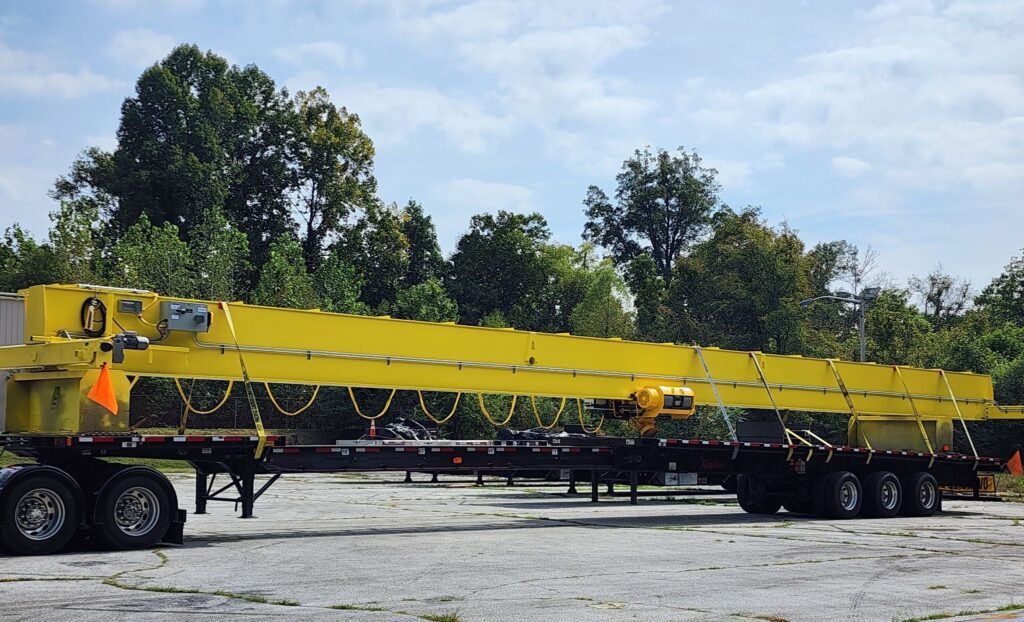
Sizing a crane for the heaviest lift you might someday make leaves many assembly plants and distribution centers paying for steel and runway support they never use. A single-girder overhead crane handles the light-to-moderate picks facilities make every shift, using one bridge beam and a simpler trolley at a lower installed cost.
Ace World Companies builds single girder systems in top-running and under-running configurations and matches each one to your span, capacity, and runway.
A single-girder bridge crane spans the bay, carried at each end by end trucks that travel the length of the runway. The hoist and trolley ride the girder’s bottom flange, so an operator can raise a load, move it across the bay, and carry it down the building from a single pendant or radio control.
Because the bridge weighs less than a two-beam system, it puts lighter wheel loads on the runway and runs on smaller travel motors, which cuts energy use and wear on drive components.
Ace pairs the girder with its own standard electric wire rope hoists and crane controls, so the hoist, end trucks, and controls all come from one manufacturer.
Hook height draws the clearest line between the two. A single-girder overhead crane hangs its hoist below the girder, reducing lifting height compared with a double-girder overhead crane, where the trolley rides on rails across the tops of two beams.
Double-girder systems also make room for walkways, auxiliary hoists, longer spans, and the heavier CMAA service classes that steel mills and foundries run on.
If your duty cycle stays in the lighter CMAA classes and your building has clearance to spare, a single girder is the more practical choice, and our overhead bridge cranes team can assess your facility to confirm which design fits.
A top-running single-girder bridge crane rides on rails fastened to the top of the runway beams, while building columns or a freestanding runway structure supports the rails. Placing the bridge above the runway lets it cover wider bays and recover the lifting height an underhung layout gives up.
An underhung crane suspends its runway from the roof trusses or ceiling steel, and the end trucks roll along the bottom flange of those runway beams.
With no support columns on the floor, forklift aisles and racking stay clear, which matters in warehouses where floor space holds inventory. Underhung bridges can also transfer between parallel runways, so one crane can serve several bays.
Our underhung crane end trucks are custom-sized to your runway flange, and our engineers verify your roof structure’s load rating before finalizing the design.
Ace World Companies has built American-made material handling equipment since 1987. The team, trusted by customers like NASA, Nissan, and Caterpillar also engineer each girder overhead crane we ship to manufacturing facilities and distribution centers.
OSHA 1910.179 calls for frequent inspections, daily to monthly, and periodic inspections every 1 to 12 months. The exact interval depends on how hard the crane works and the environment it runs in.
A monorail runs the hoist along one fixed beam, so loads can only travel a single path. An underhung crane adds a moving bridge, which lets the hoist reach any point across the bay.
Sometimes. The hoist, girder, end trucks, and runway all have to carry the new rating, so our engineers review each component before recommending an upgrade.
Service life depends mostly on duty class and maintenance. A crane matched to the right CMAA class and inspected on schedule outlasts one pushed past its rating, since hoist components and wheels wear fastest under overloaded cycles.
A crane that doesn’t match the work either sits idle or strains through every shift. Send us your bay width, required hook height, and heaviest regular lift, and our engineers will recommend the single-girder overhead crane configuration that fits your building and your budget.