
- Products
- Industries Served
- Services
- Resources
- About Us
- Blog
- Contact Us
- Products
- Industries Served
- Services
- Resources
- About Us
- Blog
- Contact Us
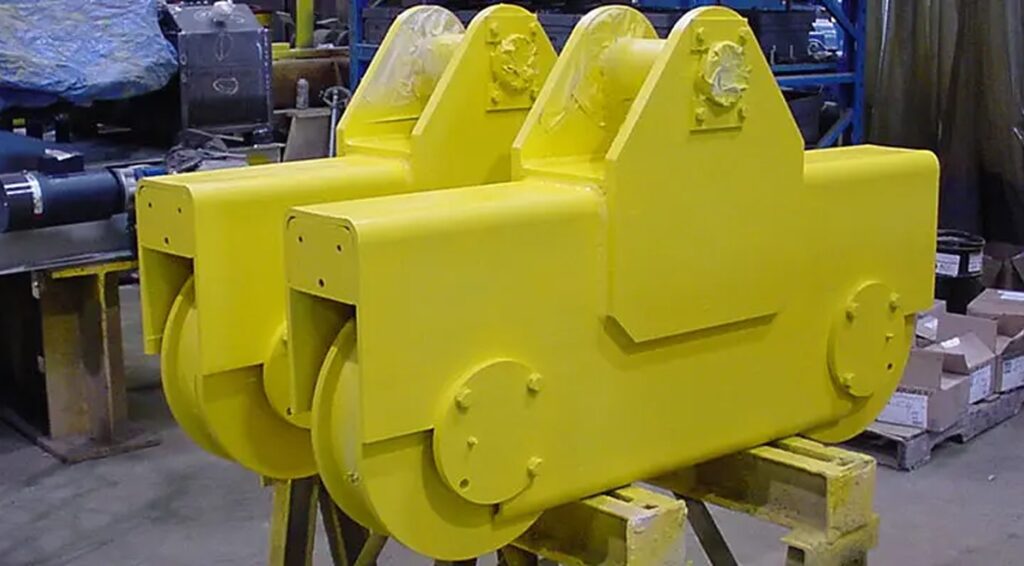
Ultra-heavy-capacity bridge cranes put more weight on the runway than a standard two-wheel end truck can carry without exceeding wheel and rail load limits. Bogie end trucks solve that problem by splitting the load across additional wheels mounted on a pivoting, self-equalizing frame, so every wheel carries its share even when the rail isn’t perfectly level or the load isn’t perfectly centered.
At Ace World Companies, we design and manufacture bogie end trucks engineered for the exact wheel load, span, and duty cycle your heavy-tonnage crane system demands, backed by decades of American manufacturing experience.
An end truck is the unit consisting of the frame, wheels, bearings, and axles that supports the bridge girders and lets the bridge travel along the runway. A bogie end truck replaces the standard single-axle, two-wheel arrangement with a compensating assembly, typically four, eight, or more wheels grouped in pairs on a pivoting equalizer beam, that distributes the bridge’s weight across a wider wheelbase instead of concentrating it on two contact points.
Bogie design describes the wheel and truck arrangement, not the bridge configuration, so it’s a different decision from choosing a top-running double-girder end truck over a single-girder one. In practice, bogies show up almost exclusively on the heaviest double-girder bridge cranes, because that’s where a standard two-wheel end truck would exceed the wheel load a rail or bearing can safely carry. A crane can be double girder without bogies, but once wheel loads climb past what a rigid two-wheel truck can handle, a bogie end truck configuration is what keeps adding capacity without moving to an oversized custom wheel.
Each bogie assembly pairs two or more wheel sets on a pivoting equalizer beam that rocks slightly as the bridge travels, so the load stays balanced across every wheel even when the runway rail has minor irregularities or the load shifts off-center. That self-adjusting action is what separates a bogie from a fixed multi-wheel truck: instead of relying on perfect rail alignment to load every wheel evenly, the bogie compensates for it mechanically.
Because the load spreads across more wheels, each individual wheel and bearing carries less weight than it would on a two-wheel truck lifting the same load. That is what allows the end truck, and the crane built around it, to handle tonnage a standard configuration can’t reach without oversized components.
Bogie end trucks are the standard solution once a bridge crane’s wheel loads exceed what a two-wheel end truck can carry, which typically means the highest-tonnage systems in steel mills, foundries, power generation plants, shipyards, and heavy fabrication facilities running near-continuous duty cycles. They also show up on long-span bridges, where the additional wheels help distribute weight more evenly across a longer runway.
Key benefits include:
Ace World Companies designs and manufactures bogie end trucks to hold up under sustained, heavy-duty use, not just to pass an initial load test. Standard design features include:
No two heavy-tonnage bridge cranes carry identical loads, spans, or duty cycles. Our engineering team designs custom bogie end trucks with capacities exceeding 1,000 tons, the highest in the industry, along with custom wheel counts, spans, and axle configurations built around your existing runway and rail size.
If you’re upgrading an aging bridge crane rather than starting from scratch, our crane modernization services team can integrate new bogie end trucks into your current structure, restoring capacity and precision without a full system replacement.
Selecting the right partner for bogie end trucks affects more than your initial purchase price. It determines how many years you get out of your bridge crane before uneven wheel loading or bearing failure forces an unplanned shutdown.
Most bogie end trucks use 4-wheel or 8-wheel configurations, with each pair of wheels mounted on a pivoting equalizer beam. The exact wheel count depends on the total wheel load the crane needs to support, not a fixed industry standard, so higher-tonnage systems may use additional wheel sets beyond the standard 4-wheel and 8-wheel options.
Capacity depends on the wheel count, bearing selection, and axle configuration built into the assembly. Ace World Companies designs custom bogie end trucks with capacities exceeding 1,000 tons, matched to the specific wheel load and runway conditions of the crane it’s built for.
Yes. Bogie end trucks can often be integrated into an existing bridge structure as part of a crane modernization project, particularly when a facility needs to increase capacity beyond what the original two-wheel end trucks can support. Retrofit feasibility depends on the existing runway, rail size, and bridge design, so an engineering review of the current structure comes first.
Bogie end trucks should follow the same inspection schedule as the rest of the crane’s load-bearing components, with wheels, bearings, and the equalizer beam checked for wear as part of routine preventive maintenance. Duty cycle and load severity affect how often components need attention, so a facility running near-continuous heavy lifts should inspect more frequently than one with occasional, lighter use.
Ready to move forward? Request a quote or talk to one of our engineers about the bogie end truck configuration your crane system needs.
Call us at 800-431-4223 to speak with an engineer or use our online Request a Quote form for fast service.
Explore our End Truck Photo Gallery for examples of past projects.