- Products
- Industries Served
- Services
- Resources
- About Us
- Blog
- Contact Us
- Products
- Industries Served
- Services
- Resources
- About Us
- Blog
- Contact Us
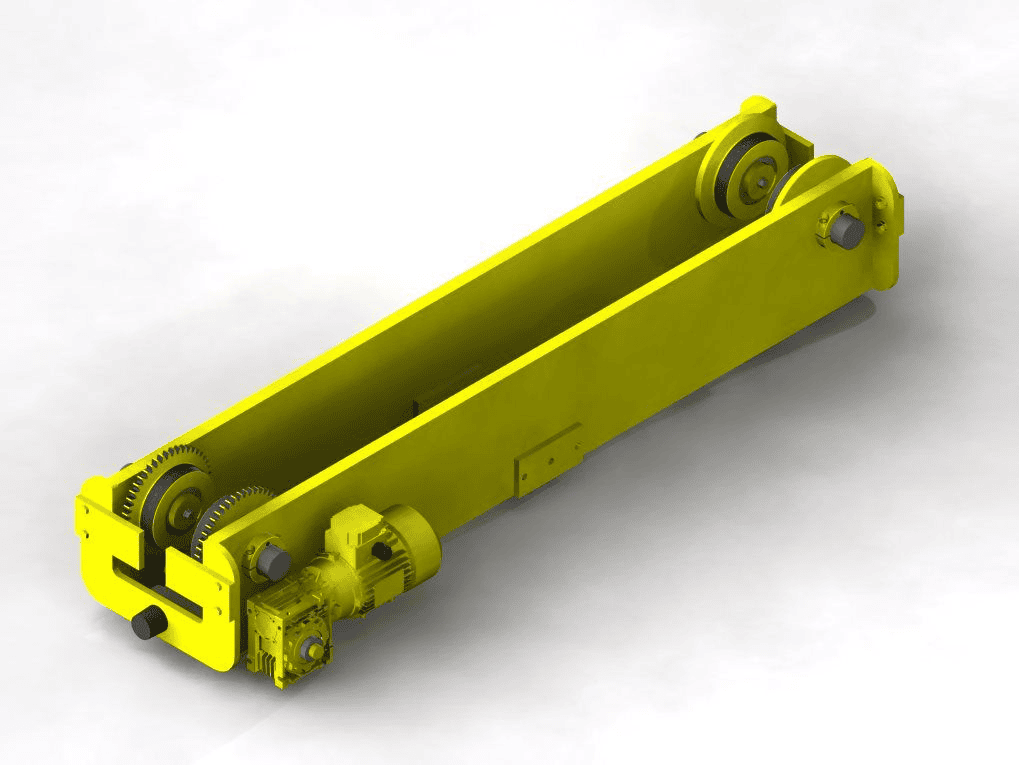
Low overhead clearance shouldn’t force a facility to run undersized lifting equipment. When a workshop, warehouse, or older building doesn’t have the roof height for a top-running bridge crane, an underhung, or under running, end truck configuration recovers the hook height a top-running system would give up. At Ace World Companies, we design and manufacture underhung end trucks engineered for the exact span, capacity, and runway your building allows, backed by decades of American manufacturing experience.
An end truck is the unit consisting of the frame, wheels, bearings, and axles that supports the bridge girders and lets the bridge travel along the runway. An underhung, or under running, end truck hangs below the bottom flange of the runway beam, with wheels riding the underside of the flange rather than the top of a rail.
This is the opposite of a top-running single-girder end truck, where the truck sits on top of the runway rail, and a top-running double-girder end truck, which pairs two girders with wheels riding on top of the runway for maximum capacity. Because an underhung end truck suspends from the runway beam rather than riding on top of it, the runway can often be supported directly from the building’s existing roof structure or columns, without dedicated support columns or an elevated rail. That trade-off caps the capacity and span an underhung system can carry, but it recovers the hook height and overhead clearance a top-running system would use up.
Each underhung end truck rides on wheels that grip the bottom flange of the runway beam, with precision-bored axles that hold the wheels in alignment, so the bridge tracks straight rather than binding against the flange. Sealed bearings keep the wheel assembly turning smoothly under repeated load cycles, the same as in our top-running lines.
Underhung systems come in both single-girder and double-girder configurations. A single-girder underhung crane uses one bridge girder with an end truck at each end, suited to lighter-duty lifts and shorter spans. A double-girder underhung crane pairs two girders for greater capacity or span while still hanging below the runway, used where a facility needs more lifting capacity than a single-girder underhung system provides but still can’t accommodate a top-running bridge.
Underhung end trucks are the standard solution for facilities where roof height, existing structural steel, or building codes rule out a top-running bridge crane. Common applications include:
Key benefits include:
Ace World Companies designs and manufactures underhung end trucks built to hold up under sustained industrial use, not just to clear an initial inspection. Standard design features include:
No two facilities share the same runway steel, ceiling height, or duty cycle. Our engineering team builds custom underhung end trucks around your existing runway flange size, span, and capacity requirements.
If you’re adding crane coverage to an existing building rather than a new structure, our crane modernization services team can integrate new underhung end trucks into your current roof structure without a full building retrofit.
Selecting the right partner for underhung end trucks determines how many years you get out of a crane system built into your building’s existing structure, where correcting a misalignment later means working around the building itself.
An underhung end truck hangs below the runway beam, with wheels gripping the bottom flange. A top-running end truck sits on top of the runway rail. Underhung systems recover overhead clearance and often mount to existing roof structure, while top-running systems generally support higher capacities and longer spans.
A single-girder underhung crane suits lighter-duty lifts and shorter spans at a lower installed cost. A double-girder underhung crane carries more capacity or span while still hanging below the runway, for facilities that need more lifting power than a single-girder system provides but can’t accommodate a top-running bridge.
Yes. Underhung systems are a common retrofit choice because the runway can often mount to a building’s existing roof trusses or ceiling joists. Our crane modernization team evaluates the existing structure before finalizing a design.
Ready to add crane coverage without giving up overhead clearance? Our team can evaluate your building and match the right underhung configuration to your space.
Call us at 800-431-4223 to speak with an engineer or use our online Request a Quote form for fast service.
Explore our End Truck Photo Gallery for examples of past projects.